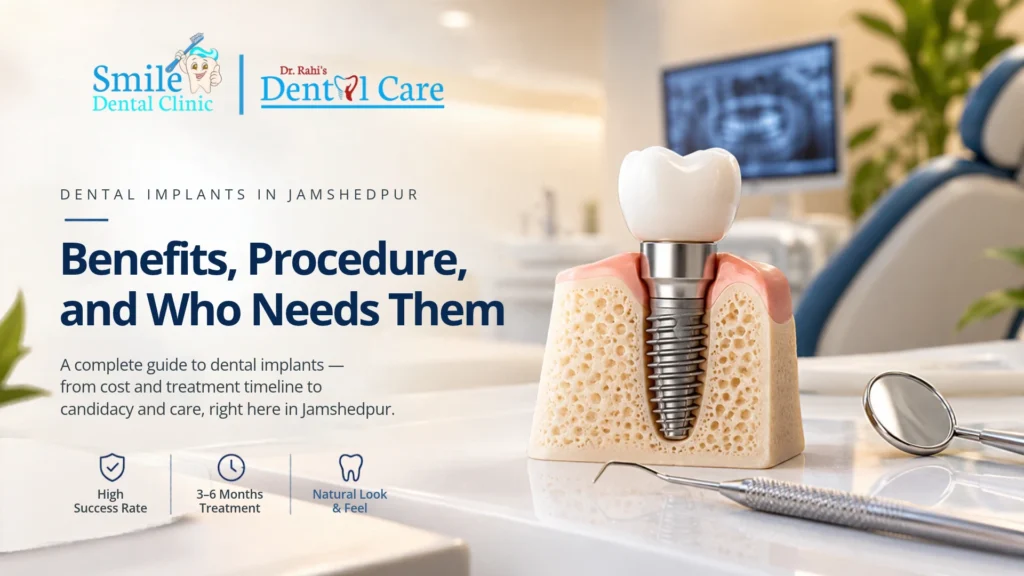
Dental implants in Jamshedpur are titanium posts surgically placed into your jawbone to replace missing teeth with a permanent, natural-feeling solution. Modern implants achieve a 95 to 98% success rate over 5 to 10 years. Treatment runs 3 to 6 months end-to-end, and single-implant pricing starts at around ₹18,000 for entry-tier systems and ₹25,000 or more for standard brands at established Jamshedpur clinics.
A dental implant is a biocompatible titanium screw that functions as an artificial tooth root. The dentist places it into the jawbone, where it fuses with surrounding bone over 3 to 6 months through a process called osseointegration. Once stable, a custom crown attaches on top, replacing the missing tooth and restoring full chewing function.
Every implant has three parts. The post sits inside the bone. The abutment acts as a connector. The crown is the tooth you actually see and chew with. Titanium stays the clinical standard because it bonds reliably with living bone. Zirconia is a newer metal-free alternative, usually priced 20 to 40% higher, and some patients prefer it on aesthetic or biocompatibility grounds. Both work. The choice usually comes down to specific bone conditions and personal preference.
Dr. Rahi Dental Care & Smile Dental Clinic, a dental implant clinic in Jamshedpur with two locations in Mango and Parsudih, places implants across all three tiers. The dental services at our Jamshedpur clinic cover single-tooth replacements, bridges on implants, and full-arch rehabilitation.
You’re a candidate for dental implants if you’ve lost one or more permanent teeth, have adequate jawbone density, and maintain reasonable oral hygiene. Implants are generally recommended once jaw growth is complete, usually after 18. There is no upper age limit for healthy adults. Smokers, uncontrolled diabetics, and heavy teeth-grinders need extra screening before placement but aren’t automatically disqualified.
The real question is less “who qualifies” and more “who benefits most.” Single-tooth loss from decay, sports injury, or a failed root canal treatment gets the clearest clinical case. Multiple adjacent missing teeth often work better as an implant-supported bridge than as individual implants. Patients who struggle with slipping dentures see genuinely life-changing outcomes with full-arch reconstructions.
And then there’s the quiet group: people with failing older bridges where the anchor teeth are now compromised. They’re our most common implant candidates, and most of them have been living with the problem for years. Ask any patient how long they’ve been avoiding specific foods. The answer tells you how much function they’ve silently given up.
The dental implant procedure runs across three distinct stages over 3 to 6 months. First, the dentist places the titanium post into the jawbone under local anesthesia. Healing follows while osseointegration happens. Then an abutment attaches, and finally a custom crown goes on. Most patients return to normal eating within days of each surgery.
Standard dental implant treatment takes 3 to 6 months from first surgery to final crown. The surgical placement itself takes just 30 to 60 minutes per tooth. Osseointegration eats most of the timeline. Some straightforward cases qualify for same-day implants, where a temporary crown goes on immediately, but final permanent crowns still wait for full bone integration.
The timeline stretches longer in a few scenarios. If you need a bone graft before placement, add 3 to 6 months. Sinus lift procedures add similar time. Smokers heal slower, so your dentist may extend the osseointegration window. According to the Cleveland Clinic Head & Neck Institute, most early failures happen inside the first 3 to 6 months when osseointegration doesn’t take. That’s why unhurried healing matters more than fast turnaround.
A single dental implant in Jamshedpur typically costs between ₹25,000 and ₹60,000 for standard brands, including the implant post, abutment, and crown. Premium systems like Nobel Biocare or Straumann push the range to ₹60,000 to ₹1,00,000 per tooth. Full-mouth rehabilitation runs between ₹2,00,000 and ₹6,00,000 depending on the technique and brand selected.
| Implant Brand Tier | Single Tooth (Post + Abutment + Crown) | Full Mouth Rehab | Typical Use Case |
|---|---|---|---|
| Entry (Phoenix, Adin) | ₹18,000 to ₹30,000 | ₹2,00,000 to ₹3,00,000 | Patients with healthy bone and single tooth loss |
| Standard (Osstem, Dentium) | ₹30,000 to ₹60,000 | ₹3,00,000 to ₹4,50,000 | Most routine implant cases |
| Premium (Nobel Biocare, Straumann) | ₹60,000 to ₹1,00,000 | ₹4,50,000 to ₹6,00,000 | Complex cases, All-on-4, aesthetic zones |
Clinics advertising ₹8,000 to ₹10,000 “complete implants” are almost always quoting the implant post alone, with the abutment and crown billed separately later. Walking out of a clinic without a written line-item quote is the single biggest avoidable mistake Jamshedpur implant patients make.
Thinking about an implant and want a clear line-item quote? Book an implant consultation at Dr. Rahi Dental Care. We quote the full package, including diagnostics and crown, before any procedure.
Tooth replacement in Jamshedpur usually means one of three options: dental implants, fixed bridges or removable dentures. Implants replace both the root and the crown and protect the jawbone. Bridges are quicker and cheaper upfront but need neighboring teeth to be ground down. Dentures cost the least but need regular replacement. The table below compares all three.
Dental implants preserve jawbone, don’t damage adjacent teeth, and routinely last 20 years or more with basic care. Bridges require grinding down healthy neighboring teeth as anchors and typically last 10 to 15 years. Dentures slip, accelerate underlying bone loss, and need replacement every 5 to 10 years. Implants cost more upfront but win on long-term value.
| Factor | Implant | Bridge | Denture |
|---|---|---|---|
| Lifespan | 20+ years | 10 to 15 years | 5 to 10 years |
| Preserves jawbone | Yes | No | No |
| Affects neighboring teeth | No | Yes (grinds them down) | No |
| Feels like natural tooth | Yes | Mostly | Rarely |
| Upfront cost per tooth | ₹25k to ₹1L | ₹10k to ₹40k | ₹8k to ₹25k |
| 10-year total cost | ₹25k to ₹1L | ₹10k to ₹80k (replacement) | ₹16k to ₹75k (replacements) |
The bridge math gets ugly after year 10. Replacing a bridge means re-grinding the anchor teeth, and after one or two replacement cycles those anchor teeth often need their own crowns, implants, or extractions. Dentures accelerate jawbone resorption because they put chewing load on gums instead of bone. Over a decade, dentures reshape the face. That’s rarely in the sales pitch.
Recovery from implant surgery takes 7 to 10 days for soft tissue healing and 3 to 6 months for full bone integration. You’ll manage mild swelling, discomfort, and a soft-food diet for the first week. Daily brushing, careful flossing around the implant, and twice-yearly professional cleanings keep the implant healthy for decades.
Specific aftercare rules that matter in the first fortnight:
Long-term, your implant needs the same hygiene attention as a natural tooth, plus one extra habit: flossing specifically around the implant base. Peri-implantitis, the infection equivalent of gum disease for implants, is the main cause of late-stage failure. The American Dental Association recommends professional cleaning every 6 months for all implant patients regardless of other dental history.
Pick a Jamshedpur clinic with specific implant experience, digital planning tools like CBCT scans and intraoral scanners, and transparent pricing that includes the implant, abutment, and crown as one quote. The dentist should discuss failure risks openly, not just success stories. Ask how many implants they place per year and which implant systems they stock.
A few concrete filter questions worth asking before you commit:
The last question is a tell. Clinics confident in their work offer written implant warranties covering 5 to 10 years. Those that dodge the question tend to also dodge accountability later. Dr. Pratish Rahi has placed implants across 18 years of practice at the Mango and Parsudih clinics, using CBCT-guided planning and a mix of standard and premium implant systems based on each patient’s bone and budget.
How much do dental implants cost in Jamshedpur?
A single dental implant in Jamshedpur typically costs ₹25,000 to ₹60,000 for standard brands, including the post, abutment and crown. Entry-tier systems start around ₹18,000, and premium brands like Nobel Biocare or Straumann cost ₹60,000 to ₹1,00,000. Always ask for a written line-item quote.
Dental implant or bridge: which is better?
Implants are usually better for long-term value because they preserve jawbone and don’t require grinding down neighboring teeth. Bridges cost less upfront and are faster, but typically last 10 to 15 years and may need replacing. Your dentist can recommend the right option after examining your bone and gums.
Is there an age limit for dental implants?
There is no upper age limit if you are in good general health and have enough jawbone. Implants are generally not recommended until jaw growth is complete, usually after age 18.
Are dental implants painful?
No, implant placement is performed under local anesthesia and most patients report less pain than a routine tooth extraction. Mild soreness for 3 to 5 days afterward is normal and manageable with standard over-the-counter painkillers. Sedation dentistry is available for patients with severe dental anxiety.
How long do dental implants actually last?
The titanium post itself routinely lasts a lifetime because it fuses biologically with the jawbone. The crown on top usually needs replacement every 10 to 15 years due to normal wear. Peer-reviewed studies report 20-year survival rates above 92% for well-maintained implants.
Can I get a dental implant if I have diabetes?
Yes, if the diabetes is well-controlled. Patients with HbA1c levels under 7% show implant success rates comparable to non-diabetic patients. Uncontrolled diabetes, however, significantly raises the risk of poor osseointegration and infection. Your dentist will usually ask for recent HbA1c results before planning the procedure.
Do dental implants need special cleaning?
They need the same basic routine as natural teeth with one addition. Brush twice daily, floss between teeth, and use an interdental brush or water flosser around the implant base to keep that specific area clean. Peri-implantitis almost always starts at the implant-gum junction, so that’s where attention matters most.
What’s the difference between a Nobel Biocare implant and a budget implant?
The main differences are the surface treatment of the titanium (which affects how quickly and reliably it fuses with bone), the quality control track record, and the available replacement part supply decades later. Premium brands have longer peer-reviewed track records and are more easily serviced globally. Budget implants can perform well clinically, but documentation and long-term parts availability can be weaker.
Can I eat normally with dental implants?
Yes, once treatment is complete you can eat practically anything a person with natural teeth can eat. Steak, apples, nuts, sugarcane. The chewing force on a healed implant matches or exceeds a natural tooth. During the 3 to 6 month healing phase, stick to softer foods and avoid chewing directly on the implant site.
If you’ve been living with a gap, a slipping denture, or a failing bridge, a 30-minute consultation will tell you most of what you need to know, including whether you’re a candidate, what the realistic cost is, and how long treatment will take. Book an appointment at Dr. Rahi Dental Care in Mango or Parsudih. Call +91 93048 27720 or email care@drrahidentalcare.in to schedule.
Step into a world of excellence and compassionate care at Dr. Rahi Dental Care & Smile Dental Clinic, where your smile is our priority!
Copyright © 2025 Dr Rahi Dental Care. All Rights Reserved